# B2B Headless Commerce: Platforms & How to Choose (2026)
B2B headless commerce explained: the architecture, what buyers now expect, platforms compared, real costs, and how to pick the right stack.
*Published 2026-09-21*
**B2B headless commerce separates the buying experience your customers use from the backend that holds company accounts, negotiated pricing and approval rules, so a procurement team can self-serve a $50,000 reorder as easily as a consumer checks out on Amazon.** [Gartner reports that 61% of B2B buyers now prefer a rep-free buying experience](https://www.gartner.com/en/newsroom/press-releases/2025-06-25-gartner-sales-survey-finds-61-percent-of-b2b-buyers-prefer-a-rep-free-buying-experience), and most legacy B2B storefronts cannot deliver one. Here is how the architecture works, what it actually costs, how the platforms compare, and how to choose without over-building.
## What Is B2B Headless Commerce?
B2B headless commerce is the same architectural idea as regular [headless commerce](/blog/what-is-headless-commerce): the storefront (the "head") is decoupled from the commerce backend (the "body") and the two talk only through an API. What makes it *B2B* headless commerce is what has to live in that backend: company accounts with multiple buyers, negotiated price lists instead of one public price, quote and approval workflows, and often a connection to a buyer's own procurement system.
A consumer storefront needs a product, a price, and a checkout. A B2B storefront needs to answer a harder question first: *who is buying, on whose behalf, at what price, and does someone else need to approve it?* That question is why most B2B teams that try to bolt wholesale onto a stock D2C platform hit a wall within a quarter, and why "headless" for B2B usually means more backend work than the consumer-facing version of the same term.
## Why B2B Buyers Are Forcing This
B2B buying behavior changed faster than most B2B storefronts did. A few numbers explain the pressure:
- **61% of B2B buyers prefer a rep-free buying experience**, per a [2025 Gartner sales survey](https://www.gartner.com/en/newsroom/press-releases/2025-06-25-gartner-sales-survey-finds-61-percent-of-b2b-buyers-prefer-a-rep-free-buying-experience) of B2B sales leaders.
- The global B2B ecommerce market is on track to pass **$36 trillion in 2026**, according to [Experro's B2B ecommerce statistics](https://www.experro.com/blog/b2b-ecommerce-statistics/), and B2B, marketplace and adjacent commerce now make up roughly two-thirds of all headless commerce platform usage, ahead of plain B2C retail, per [Mordor Intelligence's headless commerce platform market report](https://www.mordorintelligence.com/industry-reports/headless-commerce-platform-market).
- Buyers who grew up on Amazon and Shopify expect a search bar, a cart, saved reorder lists and transparent tracking, not a PDF price list and a phone call.
- The same [Mordor Intelligence report](https://www.mordorintelligence.com/industry-reports/headless-commerce-platform-market) puts large enterprises at 61% of headless commerce platform spend in 2025, but small and mid-size teams are now the faster-growing segment, at a 24% CAGR, because packaged B2B modules made headless viable below the Fortune 500.
That expectation gap is the whole business case. A legacy B2B storefront that requires a phone call to see your own negotiated price is losing orders to whichever competitor lets the same buyer self-serve.
## The Architecture: What a B2B Headless Stack Actually Needs
Swap in these primitives and the rest of the headless architecture (frontend, API layer, commerce backend) works the same as any other setup.
### Company accounts and buyer roles
A B2C customer record is a person. A B2B company account is an organization with several people attached to it: a buyer who can browse and submit for approval, an approver who signs off, and an admin who manages the account. Your data model needs a company entity above the customer entity, not just a "wholesale" tag on a regular account.
### Negotiated price lists, not one public price
The same SKU can have a dozen valid prices: list price, a distributor tier, a contract price locked in for a specific account, and a promotional override. Price resolution has to check the buyer's company and contract before it checks anything else, which is a different lookup path than a D2C storefront's single price field.
### Quotes, approvals and purchase orders
Large B2B orders rarely go straight to checkout. A buyer requests a quote, a sales rep or the system prices it, an approver signs off if it is over their limit, and the order is placed against a purchase order number rather than a credit card. Your backend needs quote and approval objects, not just a cart.
### Punchout and ERP integration
At the enterprise end, the buyer's own procurement system (SAP Ariba, Coupa, Jaggaer) opens your catalog through a standard called punchout (cXML or OCI), lets the buyer shop, and sends the cart back into their system for approval before it ever becomes an order on your side. If you sell to large enterprise buyers, punchout support stops being optional.
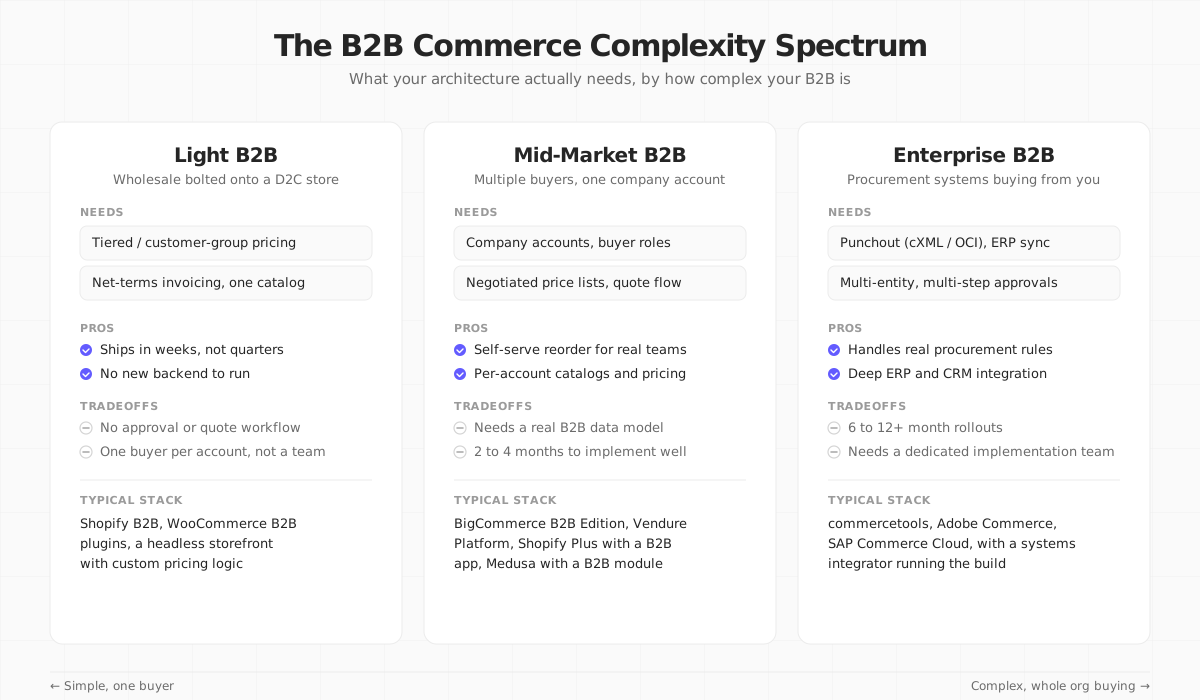
Most teams over-build here. Figure out honestly which column you are in before you pick a platform: a $2M wholesale side-channel does not need cXML punchout, and a distributor selling into Fortune 500 procurement teams cannot skip it.
## B2B Headless Commerce Platforms Compared
| Platform | B2B model | Company accounts / approvals | Pricing (September 2026) |
|----------|-----------|------------------------------|---------------------------|
| [commercetools](https://commercetools.com/products/b2b) | Composable, API-first | Yes, native B2B data model | Enterprise, quoted per project |
| [Vendure](https://vendure.io/) | Open-source core + commercial Platform | Platform tier adds B2B, self-host or Vendure Cloud | Core free (GPLv3); Platform quoted per project |
| [Adobe Commerce](https://business.adobe.com/products/commerce/commerce-b2b.html) | Enterprise suite | Yes, mature B2B module (formerly Magento B2B) | Enterprise, quoted per project |
| [BigCommerce B2B Edition](https://www.bigcommerce.com/apps/b2b-edition/) | SaaS add-on | Company accounts, price lists, quoting | Add-on on Enterprise plans, quoted |
| [Shopify Plus B2B](https://www.shopify.com/plus) | Built into Plus | Company profiles, price lists, net terms | Plus starts around $2,300/mo |
| [Medusa](https://medusajs.com/) | Open-source modules | B2B via community/commercial modules, not core | Free core; hosting and modules extra |
### commercetools: composable-first, B2B as a core product
[commercetools](https://commercetools.com/products/b2b) built its B2B data model as a first-class product, not a bolt-on: company hierarchies, buyer roles, and quote workflows are part of the core API, which is the main reason it shows up on nearly every enterprise B2B shortlist.

**Best for:** enterprise teams with a platform engineering group who want a fully composable stack and are prepared to integrate a frontend, search, and CMS separately rather than take a bundled storefront.
### Vendure: open-source core, B2B in the commercial Platform tier
[Vendure](https://vendure.io/) is a NestJS and GraphQL backend with a genuinely free, self-hostable core (GPLv3), and B2B-specific capability (approval policies, company hierarchies) sits in the commercial Vendure Platform tier, available self-hosted or through Vendure Cloud.

**Best for:** engineering teams that want to own the backend code and are comfortable paying for the B2B layer once they need it, rather than building approval workflows from scratch.
### Adobe Commerce: the deepest legacy B2B feature set
Adobe Commerce (the platform formerly known as Magento Commerce) has shipped a dedicated B2B module since 2018 and has the longest track record of any platform here for punchout, requisition lists and company credit limits. It is a large, opinionated PHP-based platform, not a lightweight API you compose around.

**Best for:** enterprises already in the Adobe ecosystem (Experience Manager, Analytics) that need proven punchout and multi-entity B2B out of the box and have the systems-integrator budget to run it.
### BigCommerce B2B Edition and Shopify Plus B2B: SaaS with B2B bolted on well
[BigCommerce's B2B Edition](https://www.bigcommerce.com/apps/b2b-edition/) is a paid add-on on Enterprise plans that adds company accounts, price lists by account, and a quoting workflow on top of BigCommerce's regular SaaS backend. [Shopify Plus](https://www.shopify.com/plus) ships company profiles, price lists and net payment terms as part of the Plus tier; Shopify has pushed basic company accounts down to lower plans over time too, but unlimited catalogs, direct company assignment and deposits stay Plus-only. Both are the pragmatic middle ground: less flexible than a composable stack, considerably faster to launch.
### Medusa: B2B if you are willing to build or buy a module
[Medusa](https://medusajs.com/) does not ship company accounts or approval workflows in its open-source core. Community and commercial modules add B2B primitives on top, which fits Medusa's plugin-first philosophy but means B2B is something you assemble rather than something that ships turned on. We cover Medusa's broader tradeoffs in our [Medusa alternatives guide](/blog/medusa-alternatives).
Every platform above markets "B2B support." Before you sign anything, ask for a live demo of the exact three workflows that matter to you: a buyer submitting an order over their approval limit, a distributor seeing their contract price instead of list price, and (if you need it) a punchout session from the buyer's own procurement tool. Marketing pages agree on features; demos reveal which ones actually work end to end.
## B2B vs B2C Headless: What Actually Changes in the Build
The frontend and API-layer concepts are identical to any [headless commerce](/blog/what-is-headless-commerce) setup. What changes is concentrated in the data model and the checkout flow:
| | B2C headless | B2B headless |
|--|--------------|--------------|
| **Account** | One person | Company with multiple buyer roles |
| **Price** | One public price (maybe with a coupon) | Contract price resolved per company, per SKU |
| **Checkout** | Card, pay immediately | Purchase order, net terms, sometimes an approval step first |
| **Catalog** | Same catalog for everyone | Per-account catalogs; some SKUs hidden entirely |
| **Integration surface** | Payments, shipping, tax | Payments, shipping, tax, plus ERP and sometimes punchout |
| **Order size / risk** | Low value, high volume | High value, lower volume, each order matters more |
The practical effect: a B2B headless build spends proportionally more time on the backend data model and account logic, and proportionally less on storefront polish, than a comparable D2C build. Budget your team's time accordingly.
## How to Choose a B2B Headless Commerce Platform
1. **Place yourself on the complexity spectrum first.** Use the diagram above honestly. Most teams overestimate how "enterprise" their B2B actually is.
2. **List the exact workflows you need**, not feature category names. "Approval workflow" means nothing until you write down who approves what, at what dollar threshold.
3. **Ask whether you need punchout.** If your buyers are large enterprises with their own procurement software, this single requirement eliminates most SaaS-only platforms.
4. **Price the whole stack, not just the license.** A composable platform's list price is a fraction of the total cost once you add a frontend build, search, and integration work.
5. **Run a real demo of your top three workflows** before signing, per the callout above.
6. **Check the migration path.** If you might outgrow the platform, understand what happens to your company accounts and price lists when you leave. Portable data models (standard REST/GraphQL, documented schemas) age better than proprietary ones.
## The Honest Cost and Timeline
Do not let a platform's list price set your budget expectations. For any of the platforms above, the license or subscription is usually the smaller line item:
- **Light B2B** (one price tier, net terms, a single catalog): weeks, largely configuration.
- **Mid-market B2B** (company accounts, negotiated pricing, a quoting flow): commonly 2 to 4 months once you include frontend work, per the timelines the platforms above publish for their B2B modules.
- **Enterprise B2B** (punchout, ERP sync, multi-entity approvals): 6 to 12 months is normal, and a systems integrator is usually involved for the ERP and punchout pieces specifically.
Budget the ongoing cost too: someone has to keep company account data, price lists and ERP sync working as your business changes, which is a permanent line item, not a one-time project cost.
### If You're in the EU or UK
B2B tax handling differs from B2C in ways that matter for your checkout logic. In the EU, a B2B sale to a VAT-registered buyer in another member state typically uses the **reverse charge mechanism**: you validate the buyer's VAT number (via VIES), zero-rate the invoice, and the buyer self-accounts for VAT in their own return. In the UK, since Brexit, the same domestic-to-domestic B2B sale carries standard UK VAT, and cross-border sales into the UK from the EU go through import VAT and postponed VAT accounting rather than the EU reverse charge. Your commerce backend needs to know your buyer's VAT status and jurisdiction before checkout, not after, so build VAT number capture and validation into the company-account step rather than bolting it onto the cart later.
## Where Your Next Store Fits
[Your Next Store](https://yournextstore.com/) is not a dedicated B2B commerce platform, and we will not pretend otherwise: there are no built-in company accounts, approval workflows or punchout in the product today. If your business is enterprise B2B with multi-step approvals and ERP-synced pricing, one of the platforms in the comparison table above is the right call, not YNS.
Where YNS does fit is the **light end of the spectrum**: a fast, modern Next.js storefront for a brand that is primarily D2C but wants to add a simple wholesale or trade-pricing channel without standing up a second platform. Because the [storefront template](https://github.com/yournextstore/yournextstore) is open source and the managed backend exposes a full REST API through the Commerce Kit SDK, you can build customer-specific pricing logic, gated collections for trade accounts, or a net-terms invoicing flow on top of it, the same way teams extend it for other custom needs. It will not save you from building company accounts and approval workflows yourself if you need them; it will save you from running a second commerce backend for a wholesale channel that is genuinely small.

The managed platform includes an AI-powered store builder, an AI assistant with a per-store knowledge base, and 0% platform transaction fees on every plan (Stripe's standard processing fees still apply), starting at $30/month on the Starter plan. See our [best ecommerce platform for developers](/blog/best-ecommerce-platform-for-developers) comparison for how it stacks up on the D2C side.
Your Next Store's storefront template is open-source. Star it on GitHub:{" "}
github.com/yournextstore/yournextstore
## FAQ
### What is the difference between B2B headless commerce and composable commerce?
Headless commerce means the frontend and backend are decoupled and talk through an API; composable commerce goes further, swapping out individual pieces of the backend itself (search, pricing, checkout) as separate best-of-breed services (MACH architecture). A B2B platform can be headless without being fully composable, and most mid-market B2B builds are headless-but-not-fully-composable for exactly the cost reasons in this guide.
### Can I add B2B features to a platform that is not built for B2B?
Yes, for light B2B: customer groups, net-terms invoicing and a single negotiated catalog can be layered onto most modern platforms, including a headless Next.js storefront. It gets significantly harder once you need company accounts with multiple buyer roles, multi-step approvals, or punchout, at which point a platform with native B2B primitives is usually cheaper than building your own.
### Do I need punchout (cXML/OCI) support for B2B headless commerce?
Only if your buyers are large enterprises that require you to sell through their own procurement software (SAP Ariba, Coupa, Jaggaer). If your buyers are small and mid-size businesses ordering directly on your site, you can skip punchout entirely and save significant implementation cost.
## The Bottom Line
B2B headless commerce is not one decision, it is three: how complex your B2B actually is, which platform ships the exact workflows you wrote down, and how much of the real cost sits outside the license. Get the first one honest and the other two get a lot easier to answer.
## Related Blog Posts
- [What Is Headless Commerce? Definition & Examples](/blog/what-is-headless-commerce)
- [Best Headless Commerce Platforms Compared](/blog/best-headless-commerce-platforms)
- [Migrating From Shopify to Headless Commerce](/blog/migrating-from-shopify-to-headless-commerce)
- [Medusa Alternatives: Open-Source and Managed Options](/blog/medusa-alternatives)