# B2B Ecommerce: How to Sell Wholesale Online
B2B ecommerce explained: set wholesale pricing, MOQs and net terms, pick a platform and handle tax. Start selling wholesale online the right way.
*Published 2026-10-06*
**B2B ecommerce is selling to businesses instead of consumers: retailers, distributors, restaurants, offices. It looks like a normal store with three differences that matter: prices depend on who is buying, orders have minimums, and the buyer pays on terms, not at the checkout.** [Gartner reports that 61% of B2B buyers prefer a rep-free buying experience](https://www.gartner.com/en/newsroom/press-releases/2025-06-25-gartner-sales-survey-finds-61-percent-of-b2b-buyers-prefer-a-rep-free-buying-experience), so a self-serve wholesale channel is no longer a nice extra. This guide shows how to build one, from pricing to payment terms to tax.
Most small brands start wholesale the same way: a retailer emails, you send a PDF line sheet, someone invoices by hand, and by the tenth buyer you are drowning in spreadsheets. The fix is not enterprise software. It is deciding a handful of rules once (who gets which price, what the minimum order is, when you get paid) and letting your store enforce them.
## B2B vs B2C Ecommerce: What Actually Changes
A wholesale buyer is not a consumer with a bigger cart. They reorder, they compare against a contract, and the purchase often needs an internal approval. Here is what differs in practice:
| | B2C | B2B / wholesale |
|---|---|---|
| **Who sees prices** | Everyone | Often only approved accounts |
| **Price** | One public price | Tiers, contract prices, volume breaks |
| **Order size** | One to a few units | Minimum order quantity (MOQ) or value, case packs |
| **Payment** | Card at checkout | Card, bank transfer or invoice on net terms |
| **Buying cycle** | Minutes | Days, with reorders on a rhythm |
| **Tax** | Charged at checkout | Often exempt or reverse-charged with a valid ID |
| **Relationship** | Anonymous | Account-based, repeat |
Everything else (product pages, shipping, returns) works the way you already know. If you are still deciding whether to add a channel at all, our guide to [starting an online store](/blog/how-to-start-an-online-store) covers the base setup.
## The Wholesale Order Flow
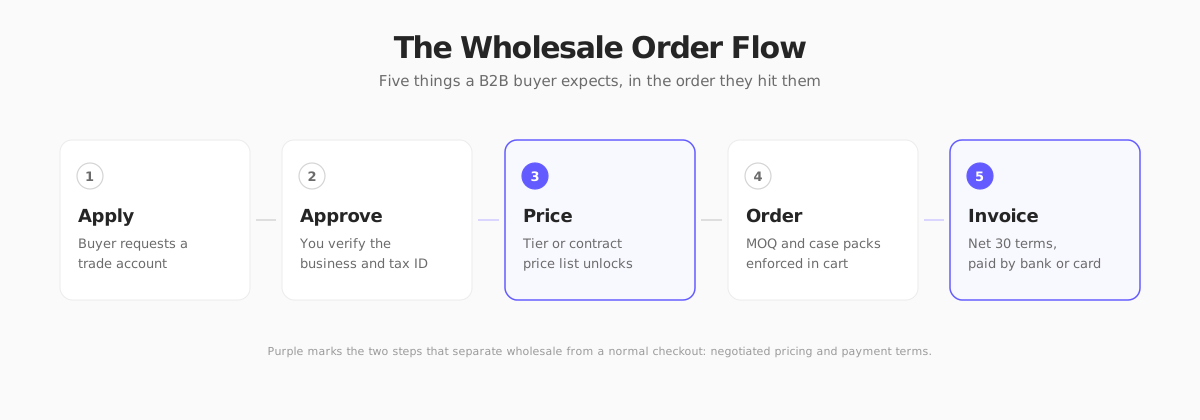
Whatever platform you use, a healthy wholesale channel runs through the same five steps. Most of the work is in steps three and five.
### 1. Apply and approve
Decide who can buy at wholesale. The simplest version is an application form that asks for a business name, website or storefront photos, and a tax or VAT ID. You approve manually at first. That gate protects your retail price: if anyone can sign up and see wholesale prices, your retail channel pays for it.
### 2. Show the right price to the right buyer
Once approved, the buyer sees wholesale prices. Never publish them openly unless you want your retailers' customers to screenshot them.
### 3. Enforce minimums and case packs
Set a minimum order value (say $250) or a per-SKU MOQ, plus case-pack multiples if you ship in cartons of 6 or 12. Enforcing this in the cart saves you the awkward email asking a buyer to add more.
### 4. Offer payment terms
Retailers expect to receive stock first and pay later. More on that below.
### 5. Make reordering effortless
Wholesale revenue is mostly repeat revenue. A buyer should be able to open their account, repeat last month's order and edit quantities in under a minute.
## Wholesale Pricing: How to Set It
The standard starting point is the keystone rule: retail price is roughly double your wholesale price, and your wholesale price is roughly double your landed cost. That gives you a 50% gross margin on wholesale and leaves the retailer a 50% margin. Treat it as a default, not a law. Some categories run tighter margins and some, like cosmetics and jewelry, run looser.
### Build tiers, not one number
A single wholesale price leaves money on the table. Volume tiers reward bigger orders and raise your average order value. A typical ladder looks like this:
| Order size | Discount off retail | Example (retail $40) |
|---|---|---|
| 1 to 11 units (retail) | 0% | $40.00 |
| 12 to 47 units | 15% | $34.00 |
| 48 to 143 units | 25% | $30.00 |
| 144+ units | 35% | $26.00 |
Those percentages are illustrative, not a benchmark. Build yours backwards from margin: know your landed cost, decide the lowest price you will accept at each volume, and check that every tier still clears your target margin after freight and payment fees. Our breakdown of [how much Shopify takes from a $100 sale](/blog/how-much-does-shopify-take-from-a-100-sale) is a useful model for working out what a platform's fees do to those tiers.
### Contract prices for key accounts
Your biggest buyers will negotiate. Keep a separate price list per account for them rather than a hidden discount code, so the price is automatic, visible to them, and auditable by you.
## Payment Terms: Net 30 Without the Chaos
Offering terms is the single feature that makes a wholesale site feel like a real wholesale site. "Net 30" means the invoice is due 30 days after it is issued. Common terms are net 15, 30 and 60.
Be careful with who gets credit. A sensible policy:
- **First order:** prepay by card or bank transfer.
- **After one or two clean orders:** offer net 30 up to a credit limit.
- **Late payers:** drop back to prepay.
If you run on Stripe, [Stripe Invoicing](https://stripe.com/invoicing) can issue the invoice, email it, send reminders and collect by card or bank transfer. [Stripe lists Invoicing Starter at 0.4% per paid invoice and Invoicing Plus at 0.5%](https://stripe.com/invoicing/pricing), on top of standard payment processing fees (checked October 2026, and pricing varies by country).

If you already take payments through Stripe, our guide on [how to sell online with Stripe](/blog/how-to-sell-online-with-stripe) explains the moving parts.
Terms are a financing decision. Selling $20,000 of stock on net 60 means you float that money for two months. Make sure your cash flow can take it before you advertise terms to everyone.
## Where to Sell Wholesale
You have three routes, and most brands end up using two.
### Option 1: A wholesale marketplace
Marketplaces such as [Faire](https://www.faire.com/) bring retailers to you, handle payment, and often offer net terms to the retailer while paying you up front. You trade a commission for demand you would not otherwise reach. They are good for finding your first 20 stockists. They are a poor place to build a direct relationship, because the retailer is the marketplace's customer first.
### Option 2: A wholesale section on your own store
You run wholesale from the same platform as your retail store, with a gated catalog, wholesale prices and terms. This is the best long-term margin and the best relationship, because you own the account and the data. It is also where platform choice starts to matter.
### Option 3: A separate dedicated B2B portal
A standalone portal makes sense for large catalogs, ERP integrations and approval workflows. For most brands under a few million in wholesale revenue, it is more than you need. We cover the deep end in our guide to [B2B headless commerce](/blog/b2b-headless-commerce).
## Choosing a Platform for Wholesale
What you need depends on how complex your B2B actually is. Be honest about which of these you are:
- **Light:** a few dozen retailers, one or two price tiers, invoice on request.
- **Mid-market:** hundreds of accounts, company profiles with multiple buyers, quoting, purchase orders.
- **Enterprise:** punchout into procurement systems, ERP-synced pricing, multi-step approvals.
For light and mid-market, a hosted platform with built-in B2B tools is usually the fastest path. [Shopify's B2B page](https://www.shopify.com/b2b) pitches company profiles, volume pricing, quantity rules and payment terms such as Net 30 from a single store. According to third-party summaries, [Shopify extended its core B2B features to its lower-priced plans in April 2026](https://www.ringly.io/blog/shopify-b2b-ecommerce), with some features, like deposits and partial payments, still limited to Plus. Check Shopify's current plan comparison before you commit, since plan contents change.

Other options include BigCommerce (B2B Edition), WooCommerce with wholesale plugins, and open-source platforms you extend yourself. If you are weighing a move, see our roundups of [Shopify alternatives](/blog/open-source-shopify-alternatives) and [BigCommerce alternatives](/blog/bigcommerce-alternatives).
### A checklist for any platform
Before you pay for anything, confirm it can do these:
- Hide prices and catalog from logged-out visitors
- Approve accounts manually
- Show different prices per customer group or company
- Enforce MOQ, order value minimums and case packs
- Offer net terms and invoicing, or integrate with a tool that does
- Handle tax exemption and VAT IDs
- Let buyers reorder from past orders
- Export orders to your accounting or ERP system
## Tax: Resale Certificates, VAT and Reverse Charge
Tax rules for B2B differ from retail, and they differ by country. Always confirm the specifics for where you and your buyers are located.
**In the US**, wholesale sales to a business that will resell the goods are generally not subject to sales tax, but only if the buyer gives you a valid resale (or exemption) certificate. State rules and certificate formats vary, so collect and store the certificate before you ship tax-free. Without it, you may be liable for the tax.
**In the EU**, a sale to a business in another member state is generally zero-rated when the buyer has a valid VAT number and the goods leave your country, with the buyer accounting for VAT under the reverse charge. You should validate the buyer's VAT ID, for example through the European Commission's [VIES service](https://ec.europa.eu/taxation_customs/vies/), and keep the proof with your records.
**In the UK**, VAT-registered business buyers charge and reclaim VAT as normal, and you should record their VAT number on the invoice. Post-Brexit, sales between Great Britain and the EU involve customs paperwork on top of VAT.
If you ship abroad, read [how to sell internationally](/blog/how-to-sell-internationally) for duties and shipping basics.
**Always check the current rules where you sell.** This guide summarizes US, EU and UK B2B tax treatment as of October 2026. Rules change and vary by country and state, so confirm the details with your local tax authority or an accountant before you sell tax-free. This is general information, not tax or legal advice.
## Shipping and Fulfillment for Wholesale
Wholesale orders ship heavier and less often. A few habits help:
- **Quote freight clearly.** Offer free shipping above a threshold, or a flat per-carton rate, so buyers can predict landed cost.
- **Pack to retailer expectations.** Case packs, barcodes on every unit and clear packing slips reduce receiving problems.
- **Set lead times.** Retailers plan seasons months out. Publish your production and shipping lead times, especially for made-to-order items.
- **Separate retail and wholesale inventory** if stock is tight, so a wholesale order cannot oversell a retail launch.
## Getting Your First Wholesale Buyers
A wholesale page does nothing until buyers find it. Reliable early channels:
1. **Your existing customers.** Independent shops often start as customers who say "I should stock this." Add a "Become a stockist" link in your footer.
2. **Local and independent retailers.** Send samples with a line sheet and your terms.
3. **Trade shows and markets.** Still the fastest way to meet many buyers in a day.
4. **Marketplaces.** Use one to find your first stockists, then invite the best ones to reorder directly on your own site.
5. **Outbound email.** A short note with a link to your wholesale page and one clear incentive, such as free shipping on a first order.
Protect your brand while you do it: set a minimum advertised price policy where it is legal in your market, and be selective about who you approve.
## Where Your Next Store Fits
We build [Your Next Store](https://yournextstore.com/) (YNS), so here is the honest version. YNS is not a dedicated B2B platform. There are no built-in company accounts, approval workflows or punchout today. If you need those, pick a platform from the options above.

Where YNS fits is the light end: a fast, modern storefront for a brand that is mostly selling direct and wants a simple wholesale channel without running a second platform. The [storefront template](https://github.com/yournextstore/yournextstore) is open source, and the managed backend exposes a REST API through the Commerce Kit SDK, so developers can build gated trade pages or customer-specific pricing on top. Plans are flat, with 0% transaction fees, so wholesale orders do not pick up a platform commission (Stripe's processing fees still apply). See [pricing](https://yournextstore.com/pricing) for current plans.
## Common Mistakes to Avoid
- **Publishing wholesale prices publicly.** Gate them behind approved accounts.
- **Offering terms to everyone.** Start with prepay, earn your way to net 30.
- **Setting one flat wholesale price.** Tiers raise order size.
- **Ignoring tax documents.** No resale certificate or VAT ID, no tax-free invoice.
- **Making buyers email to reorder.** Self-serve reordering is where wholesale scales.
- **Underpricing to win the first account.** It becomes the floor every other buyer quotes.
## FAQ
### What is B2B ecommerce?
B2B ecommerce is the online sale of goods or services between businesses, such as a manufacturer selling to retailers or a distributor selling to restaurants. Compared to consumer ecommerce, it typically involves account-based pricing, minimum order quantities, larger and repeat orders, and payment on terms instead of a card at checkout.
### How do I start selling wholesale online?
Decide your wholesale prices and minimum order, add a gated wholesale section or portal to your store, create an application form to approve buyers, and set your payment terms. Start with a handful of retailers you already know, then add a marketplace or outbound outreach once your process works.
### What is a good wholesale discount?
A common rule of thumb is that wholesale is about 50% of retail (the keystone rule), which leaves both you and the retailer a healthy margin. The right number depends on your category and costs. Work backwards from your landed cost and target margin, then add volume tiers for larger orders.
### Do I need a separate website for wholesale?
Not usually. Most small and mid-size brands run wholesale from a gated section of their main store, which shares inventory, products and checkout. A separate portal makes sense when your catalog, integrations or approval rules are complex enough to need their own system.
### How do net 30 payment terms work?
You ship the order and send an invoice due 30 days later. The buyer pays by bank transfer or card within that window. To manage the risk, start new buyers on prepay and extend credit only after a few successful orders.
## The Bottom Line
B2B ecommerce is a normal store plus three rules: price by buyer, set minimums, and get paid on terms. Decide those once, let the store enforce them, and wholesale stops being a spreadsheet and starts being a channel.
## Related Blog Posts
- [B2B Headless Commerce: Platforms & How to Choose (2026)](/blog/b2b-headless-commerce)
- [How to Sell Internationally](/blog/how-to-sell-internationally)
- [How to Sell Online With Stripe](/blog/how-to-sell-online-with-stripe)
- [How to Start an Online Store](/blog/how-to-start-an-online-store)